
Introduction
Thank you for purchasing the Smart Wireless Force Accelerometer. We pride ourselves on producing high quality products that meet with the demands of the busy classroom environment. If you have any problems using this sensor, please read this documentation in full before contacting the Data Harvest Support Team.
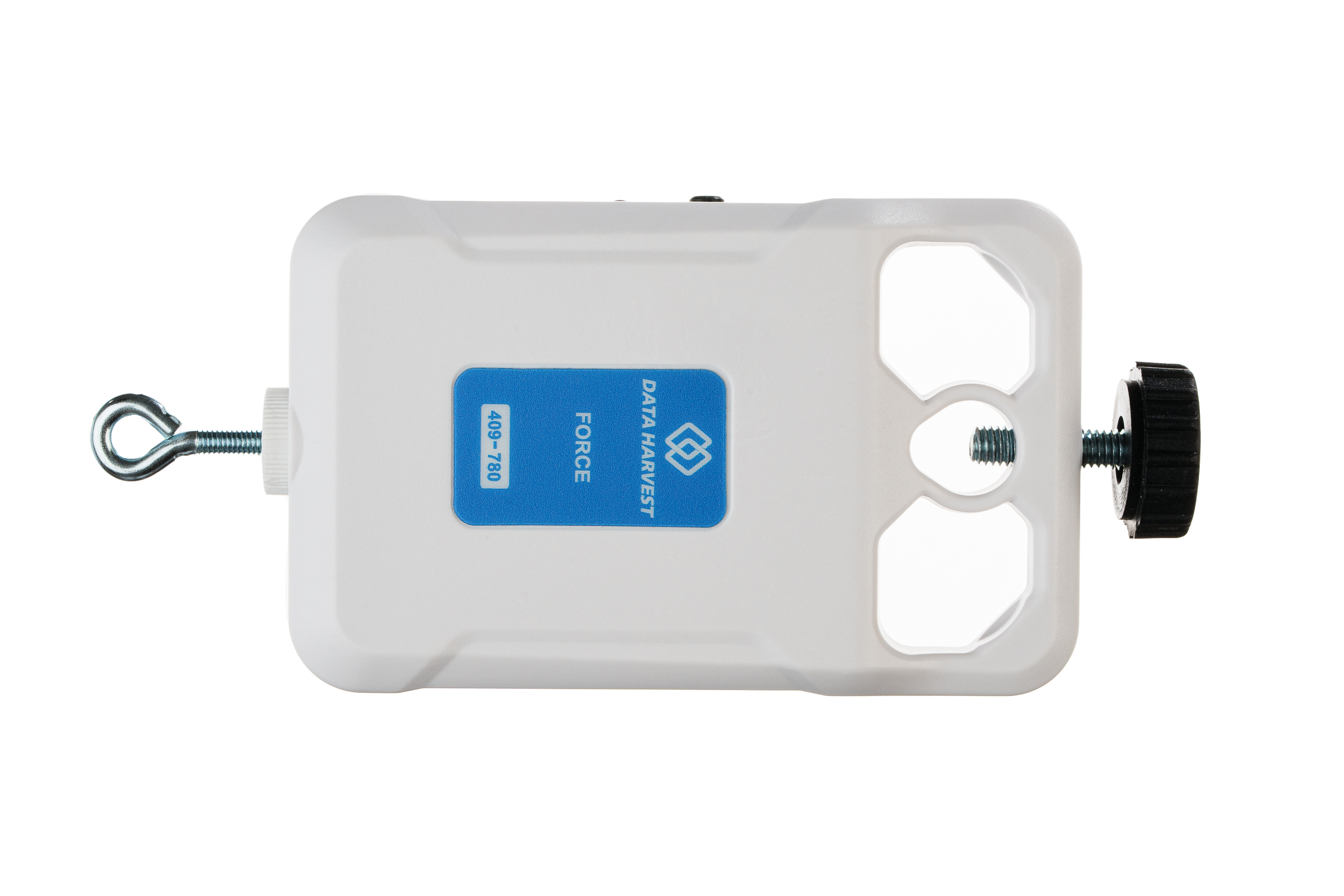
Overview
The Wireless Force Sensor incorporates the following measurement capabilities:
- Force sensor: Measures forces in the range –100 N to 100 N.
- Accelerometer: Measures acceleration simultaneously along three axes over a range of 0 to 150 m/s².
- Gyroscope: Measures angular velocity about three axes (one axis at a time) over a range of 0 to 8 m/s.
The force sensor is an aluminium load cell with a 3 mm threaded mounting point for attaching accessories. The accelerometer and gyroscope are silicon MEMS (Micro-Electro-Mechanical Systems) sensors mounted on the circuit board.
At the top of the sensor are two finger holes to allow the user to hold the device securely. Between these is a smaller ovoid mounting hole fitted with a screw, enabling the sensor to be fixed firmly to a metal rod. The ovoid shape ensures the mounting rod is centred correctly within the sensor.
The Wireless Force Sensor is a versatile instrument suitable for a wide range of practical investigations, including:
- Force changes during a pendulum swing
- Force–extension measurements for Hooke's law
- Impulse experiments
- Static and kinetic friction
- Measuring gravitational acceleration (g)
- Free-fall investigations
- Demonstrating Newton's Second Law (F = ma)
The sensor supports high-speed data acquisition, with a minimum inter-sample time of 50 μs when it is the only sensor connected. Recording multiple measurement ranges from the same sensor does not affect this rate. However, connecting additional sensors increases the minimum inter-sample time, reducing the maximum sampling rate.