
4.2.3.3 Apparatus
Several timing devices are supported and are dedicated to experiments.
The following summarises their type and usage.
Single Interrupt card
Measure the solid part of the card that will pass through the Light Gate (mm). Speed is calculated using the length of the interrupt card divided by the time taken for the card to pass.
Double Interrupt card
The two segments of a double interrupt card must be equal in width. Measure the solid part of the card that will pass through the Light Gate (mm).
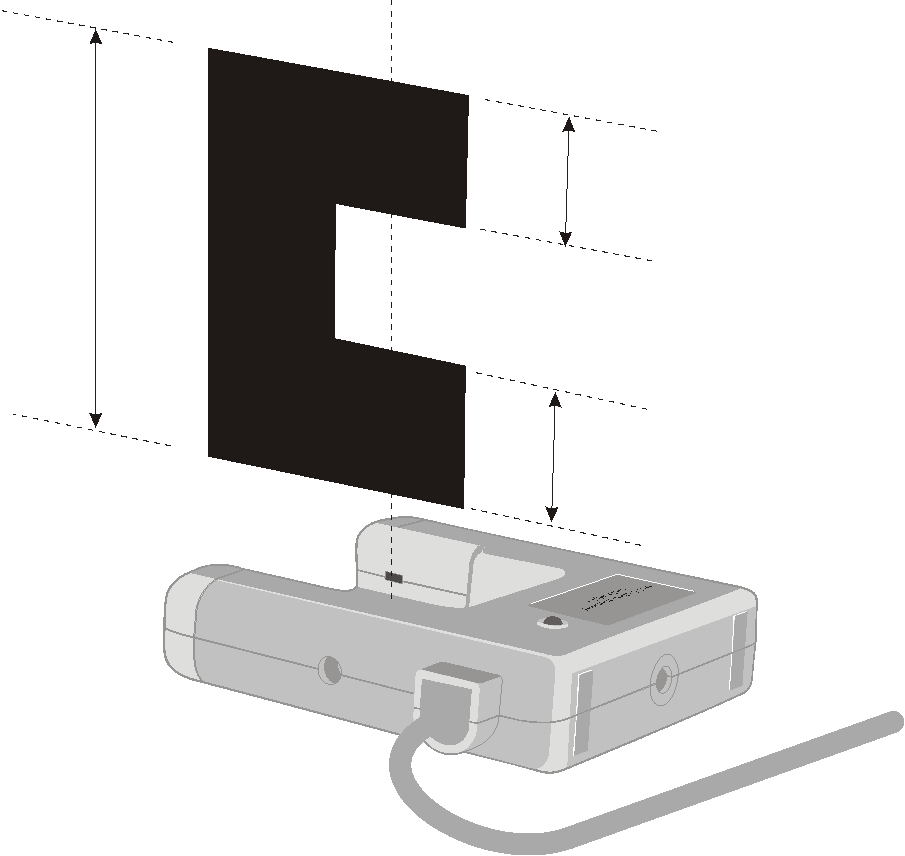
Picket fence
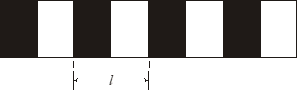
The picket fence is a multi-segmented interrupt card so a sequence of measurements will be taken.
To improve the accuracy of readings, a calculation increment can be applied to average the times over fewer pitches.
Note: A calculation increment (of more than 1) will result in fewer measurements than the number of pitches on a fence might indicate.
|
Pitch length (l) |
Suggested calculation increment |
|
60 mm or more |
1 |
|
50 mm |
2 |
|
40 mm |
2 |
|
30 mm |
3 |
|
20 mm |
4 |
|
*10 mm |
5 - 8 |
*Note: If a picket fence with a pitch length of 10 mm is used with buggy type investigations (which produce slower times than gravity investigations), the times can be averaged over fewer pitches so the calculation increment could be reduced to five.
When a Picket fence is used to measure speed or acceleration, the measurements shown are for instantaneous values.
Spoked Pulley
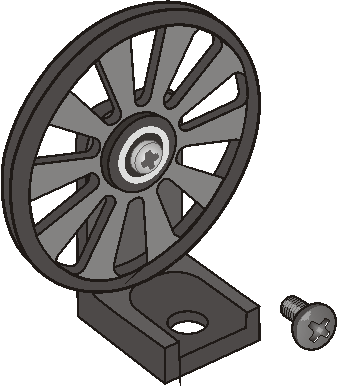
Measurement types for the Data Harvest Spoked Pulley are pre-defined. The spokes on the pulley can easily interrupt the Light Gates beam to create false results. Wait until all is ready before you click on the Start icon.
When a Spoked Pulley is used to measure speed or acceleration for example, the measurements shown are for instantaneous values i.e. at this distance, the speed was this value.